Dull and uneven skinIngredient
Glycolic Acid for Skin: What It Does and How Often to Use It
The smallest AHA. It loosens dead surface cells so they shed; at 5% it improved texture and discoloration against placebo. Two or three nights a week.
Published September 21, 2026 · 6 min read · 5 sources · By N/FORM
- The evidence
- 2 clinical trials, 3 reviews
- In these formulas
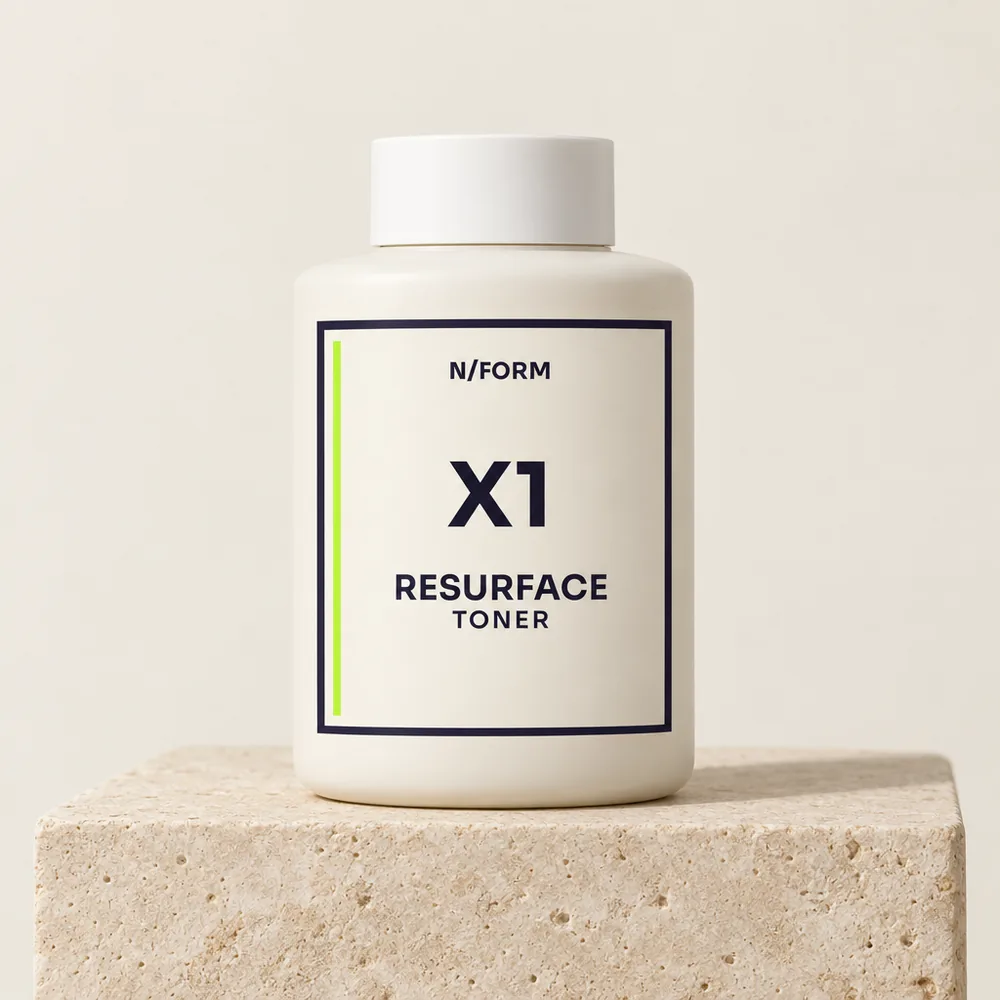
- Resurface Toner
The short version
- Glycolic acid is the smallest alpha hydroxy acid. It loosens the bonds between dead surface cells so they shed, thins the compacted outer layer and, with regular use, thickens the living epidermis underneath.
- In a double-blind, placebo-controlled trial, 75 volunteers used 5% glycolic acid daily for three months and their skin texture and discoloration improved significantly against placebo.
- Two or three evenings a week is the schedule for a 5% toner. Daily use is what the trial tested and is the ceiling, not the recommendation; irritation from an AHA rises with concentration and falling pH.
- Glycolic acid raises sun sensitivity while in use, so it belongs in the evening and needs a sunscreen every morning for as long as it is in the routine.
Glycolic acid is an alpha hydroxy acid (AHA), the family of water-soluble exfoliating acids, and the smallest molecule in it, which is why it is the one most often chosen for the face. It is a chemical exfoliant: rather than scrubbing dead cells off, it loosens the bonds that hold them to each other so they shed on their own. What glycolic acid for skin does, in one sentence, is clear the compacted layer of dead cells that makes skin look dull and feel rough, and over months it evens tone.
What it does
The outer layer of your skin (the stratum corneum) is a stack of flattened dead cells held together by protein bonds and set in lipids. Those cells are meant to shed on a schedule. When they do not, the layer thickens and compacts, scatters light instead of reflecting it, and feels rough. Glycolic acid loosens the bonds between those dead surface cells, which thins the compacted layer, and with regular use it thickens the living epidermis underneath1. At cosmetic strengths, AHAs exfoliate and improve texture and pigmentation; their irritation potential rises with concentration and as the pH falls2.
Two things follow from that. The first is that glycolic acid works at the surface, cycle after cycle, rather than reaching down and changing anything deep. The second is that its side effects are the same mechanism taken too far: thin the layer past the backlog and you reach living cells, which is where stinging and redness come from. The same review notes that AHAs raise sun sensitivity while in use1.
What the trials found
The trial that matters for a 5% product is a double-blind, placebo-controlled study in which 75 volunteers used 5% glycolic acid daily for three months; skin texture and discoloration improved significantly against the placebo3. That is the concentration Resurface Toner carries, tested in people, with a control. Two honest notes on it. It used the acid daily, which tells you daily use was tolerated for three months, not that daily use is needed to get the result. And it was a three-month trial, which is the timescale to expect: texture changes first, discoloration follows.
The broader review of cosmeceutical ingredients (retinol, vitamin C, niacinamide, hydroxy acids, peptides) makes the point that the quality of the evidence varies widely from ingredient to ingredient, and that concentration and formulation decide whether an ingredient does anything at all4. Hydroxy acids are among the better-evidenced group in that review, and 5% is a strength with a controlled trial behind it rather than a strength picked for the label.
How much, and in what
Cosmetic glycolic acid products run from a few percent to around 10%; professional peels go far higher and are a different category. The trial evidence above is at 5%3. Resurface Toner carries 5% glycolic acid in a toner with betaine and sodium PCA, both humectants, and cranberry fruit extract. It is a leave-on toner applied to clean, dry skin in the evening, two or three evenings a week, with moisturizer after.
Why not daily, if the trial was daily. Because irritation from an AHA rises with concentration and with falling pH2, and the backlog of dead cells that the acid clears is gone in a few nights. Every extra night after that is acid on living cells for no extra result, plus another day of raised sun sensitivity1. Two or three evenings gets the exfoliation with a margin. The full frequency guide, by skin type and with the signs of overdoing it, is how often to exfoliate.
Who it suits, and who should go carefully
Glycolic acid suits skin with build-up, uneven tone and rough texture: the dull, gray cast that moisturizer does not lift, the patchiness of old sun and old breakouts, the roughness under foundation. That is the skin the routine for dull, uneven skin is written for.
Go carefully if your skin is sensitive or reactive. Start at once a week and stop if the next morning is red or plain moisturizer stings. Do not use it on a barrier that is already damaged, on skin that is raw from a breakout, or on the same night as a retinoid, a scrub or another acid. Resurface Toner is not fragrance-free: it contains phenethyl alcohol, which carries a scent, so anyone avoiding fragrance should know that before starting. And because AHAs raise sun sensitivity while in use1, the product belongs in the evening slot and comes with a sunscreen obligation every morning.
What it works with
Sunscreen. Not optional. The trial that settles daily use followed 903 adults for 4.5 years: those assigned to daily sunscreen showed no detectable increase in skin aging, against 24% more in the discretionary-use group5. On a face using an AHA, the case is stronger still.
Vitamin C. In the same routine, at different times of day: vitamin C in the morning, glycolic acid in the evening. The guide on glycolic acid and vitamin C together explains why the pH worry belongs to pure ascorbic acid and why irritation is the real reason to separate them.
Salicylic acid. A beta hydroxy acid, oil-soluble, that works inside the pore where glycolic acid works on the surface. Oily and congested skin often uses both, on different nights. The salicylic acid page covers it.
A humectant and a moisturizer after. The acid thins the dead layer; the humectants and lipids in a moisturizer give the layer underneath water and keep it there. Apply moisturizer a minute after the toner on every acid night.
Questions people ask
What does glycolic acid do for your face?
It loosens the bonds between the dead cells on the surface so they shed, thins the compacted layer that makes skin look dull and feel rough, and over time thickens the living epidermis underneath1. At 5%, used for three months, that showed up as significantly better texture and discoloration against placebo in a controlled trial of 75 people3.
How often should you use glycolic acid for skin?
Two or three evenings a week at 5%. Sensitive skin starts at once a week. Irritation from an AHA rises with concentration and falling pH2, and the dead-cell backlog that the acid clears does not rebuild overnight, so more frequent use adds irritation without adding results.
Does glycolic acid help with dark spots?
It helps with the flat, brown kind by moving pigmented surface cells along sooner, and the 5% trial recorded a significant improvement in discoloration over three months3. It does not fill scars or change texture below the surface. Sunscreen every day is the condition, because AHAs raise sun sensitivity1 and sun keeps dark spots going.
Does glycolic acid make your skin sensitive to the sun?
Yes, while you are using it1. Apply it in the evening, never the morning, and wear a broad-spectrum sunscreen every day the acid is in your routine.
Is 5% glycolic acid strong enough?
It is the strength with the placebo-controlled evidence: 75 volunteers, three months, significantly improved texture and discoloration3. Higher percentages exist and irritate more, since irritation rises with concentration2; for a leave-on toner used a few evenings a week, 5% is the strength the evidence supports.
Sources
Every study cited above, with what it found and where it can be read. A study of an ingredient is not a study of one of our formulas, and we say which kind each one is.
- 1
Kornhauser, Clinical, Cosmetic and Investigational Dermatology, 2010
Review
Review of hydroxy acids: AHAs such as glycolic acid loosen the bonds between dead surface cells, thin the compacted outer layer and thicken living epidermis; they also raise sun sensitivity while in use.
- 2
Tang and Yang, Molecules, 2018
Review
Review of alpha-hydroxy acids: at cosmetic strengths they exfoliate and improve texture and pigmentation, and their irritation potential rises with concentration and falling pH.
- 3
Thibault, Dermatologic Surgery, 1998
Clinical trial
75 volunteers used 5% glycolic acid daily for three months, double-blind and placebo-controlled; skin texture and discoloration improved significantly against placebo.
- 4
Levin and Momin, Journal of Clinical and Aesthetic Dermatology, 2010
Review
Review of the evidence behind common cosmeceutical ingredients (retinol, vitamin C, niacinamide, hydroxy acids, peptides): the evidence quality varies widely and concentration and formulation decide whether an ingredient does anything.
- 5
Hughes, Annals of Internal Medicine, 2013
Clinical trial
Randomized trial, 903 adults, 4.5 years: daily sunscreen use showed no detectable increase in skin ageing, against 24% more ageing in the discretionary-use group.
The formula this guide points at
Not sure which of these is your skin?
Seven questions about what your skin does, not what you own, and you get the three formulas that treat it. Sixty days to find out, full refund, keep the bottles.
Read next
Dull and uneven skinGuide
How Often Should You Exfoliate Your Face?
Two or three evenings a week with a 5% glycolic acid toner is the answer for most skin. Here it is by skin type, with the signs you have overdone it.
7 min read · 6 sources
Dull and uneven skinGuide
Can You Use Glycolic Acid and Vitamin C Together?
Yes. Vitamin C in the morning, glycolic acid on its two or three evenings, and they never meet. Why the pH worry is mostly about pure ascorbic acid.
6 min read · 6 sources
Oily and congested skinIngredient
Salicylic Acid: What It Does for Skin, and How Often to Use It
Salicylic acid is the oil-soluble exfoliating acid, so it clears inside the pore rather than only at the surface. What the trials found and how often to use it.
5 min read · 5 sources
Dull and uneven skinRoutine guide
The Routine for Dull, Uneven Skin
Dull skin is dead cells scattering light, too little water and patchy pigment. The routine that fixes all three, from cleanser to sunscreen.
9 min read · 9 sources