Dull and uneven skinGuide
How to Fade Acne Marks (Dark Spots and Red Marks After Breakouts)
Marks are flat pigment or redness left after a breakout; scars are texture. Stop the inflammation, wear sunscreen, then vitamin C and glycolic acid.
Published September 21, 2026 · 7 min read · 7 sources · By N/FORM
The short version
- An acne mark is flat and is a color, brown (post-inflammatory hyperpigmentation, PIH) or red and pink (post-inflammatory erythema, PIE). A scar is a change in texture, a pit or a bump, and needs a dermatologist, not a serum.
- The first step is to stop the inflammation, because every new breakout leaves a new mark. Treatment of post-inflammatory hyperpigmentation starts with stopping the inflammation and daily sun protection before any lightening agent.
- Vitamin C and glycolic acid are the two topical steps for pigment. Ascorbyl glucoside lightened sun spots significantly at 12 and 24 weeks in a half-face trial; 5% glycolic acid improved discoloration over three months against placebo.
- Marks take months, not weeks. A skin cell takes 40 to 56 days to reach the surface and shed, and pigment that sits deeper takes several cycles. Marks are more common and longer-lasting in darker skin.
How to fade acne marks comes down to three things: stop the breakouts that make them, protect the marks from the sun every day, and then use vitamin C in the morning and glycolic acid two or three evenings a week to move the pigment out faster than it would go on its own. Marks fade in months, not weeks. Before any of that, check what you are looking at: a mark is flat and is a color, a scar is a change in texture, and only the mark responds to skincare.
A mark is a color, a scar is a texture
Run a fingertip over the spot with your eyes closed. If you cannot feel it, it is a mark. If there is a pit, a ridge or a firm bump, it is a scar, and no topical product fills a pit or flattens a ridge; that is a dermatologist's work, with procedures rather than serums. This guide is about marks.
Marks come in two colors. Brown marks are post-inflammatory hyperpigmentation (PIH): the inflammation of the breakout triggered pigment cells to make extra melanin, and that melanin was delivered into the surrounding skin cells, where it stays until those cells are shed. PIH follows any inflammation, not only acne, including injury and irritation from products, and it is more common and longer-lasting in darker skin1. Red or pink marks are post-inflammatory erythema (PIE): not pigment but the redness left where small blood vessels dilated during the breakout and have not yet closed down. PIE is more visible on lighter skin and tends to fade on its own as the vessels recover, which makes it less responsive to pigment-targeting ingredients and more responsive to time and to leaving the area alone.
Most people with breakouts have both, and the same routine handles both, because its first two steps are not about pigment at all.
Step one is stopping the inflammation
Every active breakout is a mark in waiting. The review of post-inflammatory hyperpigmentation puts the order plainly: treatment starts with stopping the inflammation and daily sun protection before any lightening agent1. A lightening serum applied over skin that is still breaking out is bailing a boat with the tap running.
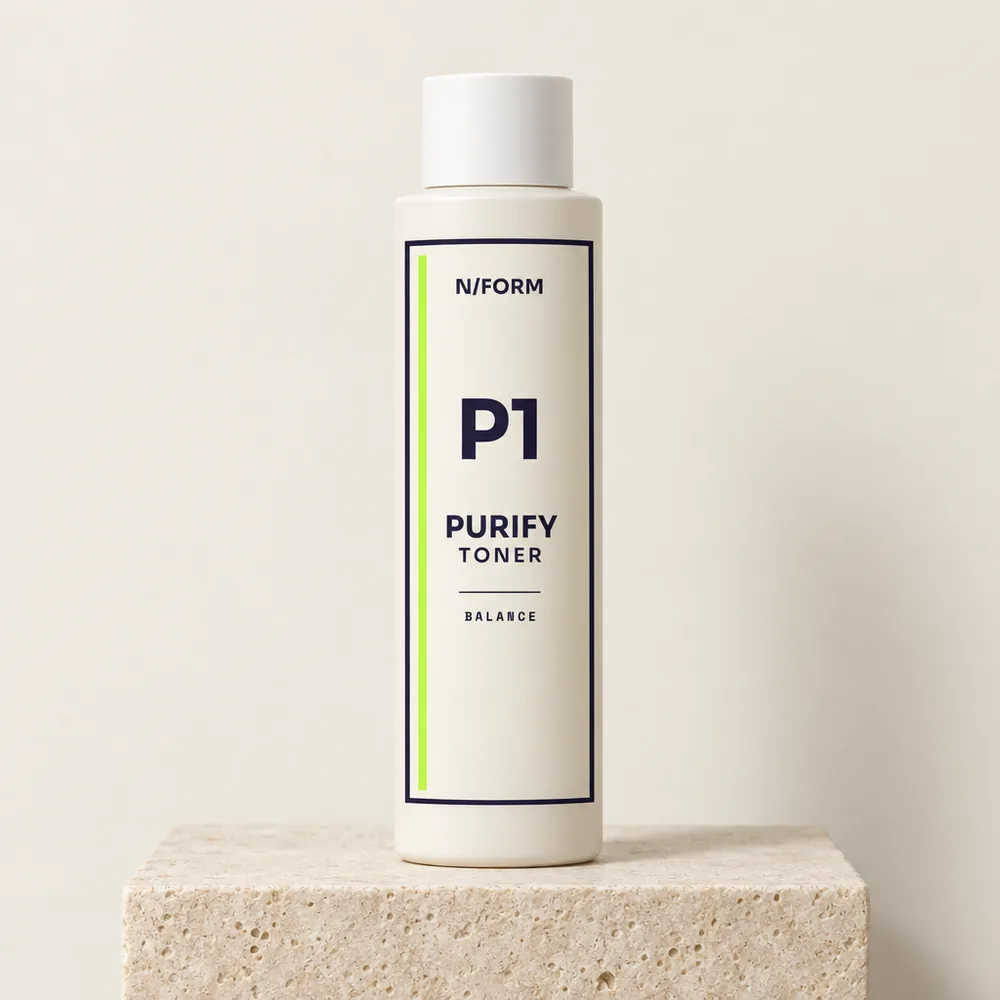
That means the acne routine comes first. For congested, oily skin that is a salicylic acid toner, which is oil-soluble and works inside the pore. Purify Toner carries it without fragrance. It also means not picking, not squeezing, and not scrubbing, because each of those is an extra dose of inflammation on a spot that was already going to leave a mark. If a new product has set off a crop of spots and you are not sure whether it is a purge or a reaction, the guide on purging versus breaking out draws the line; a reaction is inflammation and will leave marks.
Step two is sunscreen, every day, on the marks
Ultraviolet light drives pigment production, so a brown mark left in the sun darkens and a fading one stalls. The PIH review lists daily sun protection alongside stopping the inflammation as the foundation that comes before any lightening ingredient1. The strongest general evidence for daily use is a randomized trial of 903 adults over 4.5 years: daily sunscreen users showed no detectable increase in skin aging, against 24% more in the group who used it at their own discretion2. We do not sell a sunscreen. Use a broad-spectrum one every morning as the last step, and be honest about whether you are using it daily or only on days that look sunny, because the marks can tell the difference.
Step three is vitamin C in the morning
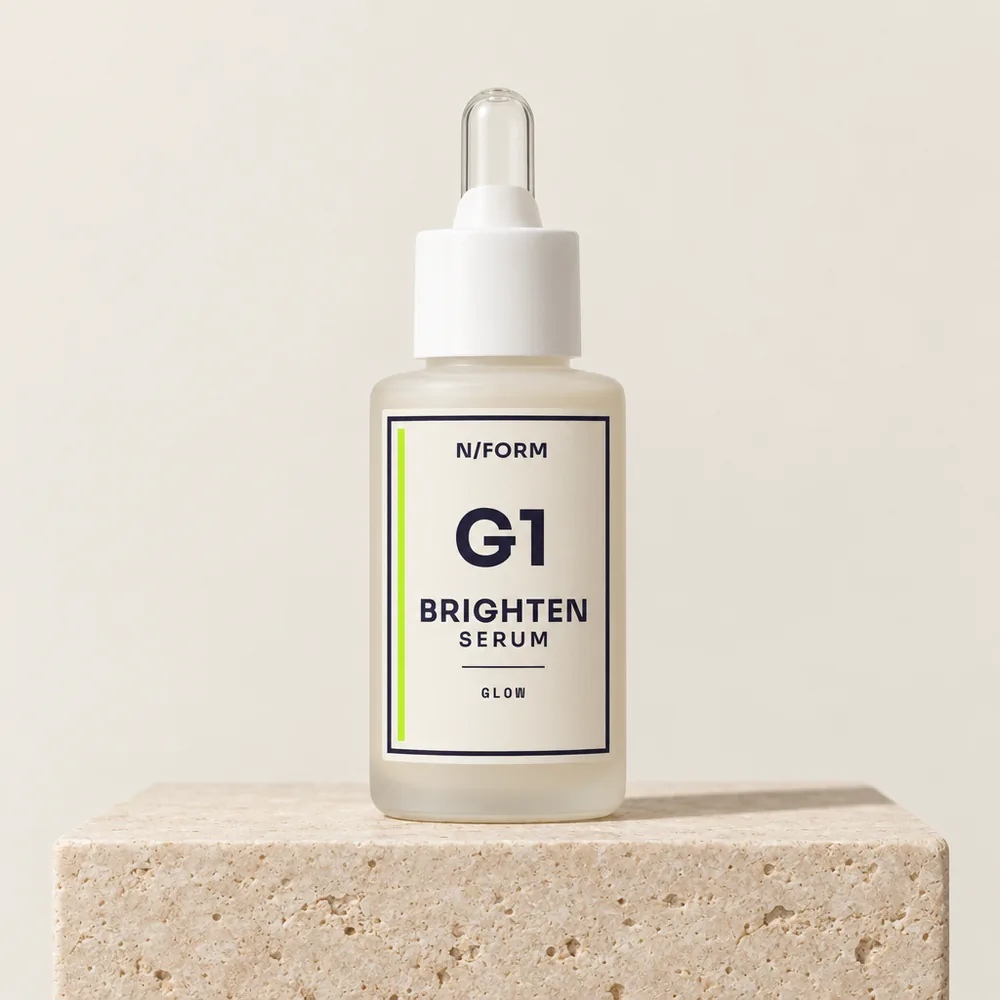
Topical vitamin C is an antioxidant that supports collagen synthesis and reduces melanin formation; pure ascorbic acid is unstable and needs a low pH, which is why stabilized derivatives exist3. Brighten Serum carries 2% ascorbyl glucoside, one of those derivatives, with 1% ferulic acid.
The trial to know about is a 24-week, double-blind half-face study: 27 women with sun spots used ascorbyl glucoside on one side of the face and placebo on the other, and the ascorbyl glucoside side had lightened significantly at 12 and 24 weeks4. Two of its authors work for the manufacturer, which the paper declares. And the spots in that trial were sun spots, not the marks left by breakouts. Both are melanin sitting in the skin, which is why the ingredient is used for both, but the acne-mark evidence for ascorbyl glucoside is inferred from the sun-spot trial and the mechanism, not measured directly. The vitamin C page covers what the glucoside trades for its stability.
Step four is glycolic acid, two or three evenings a week
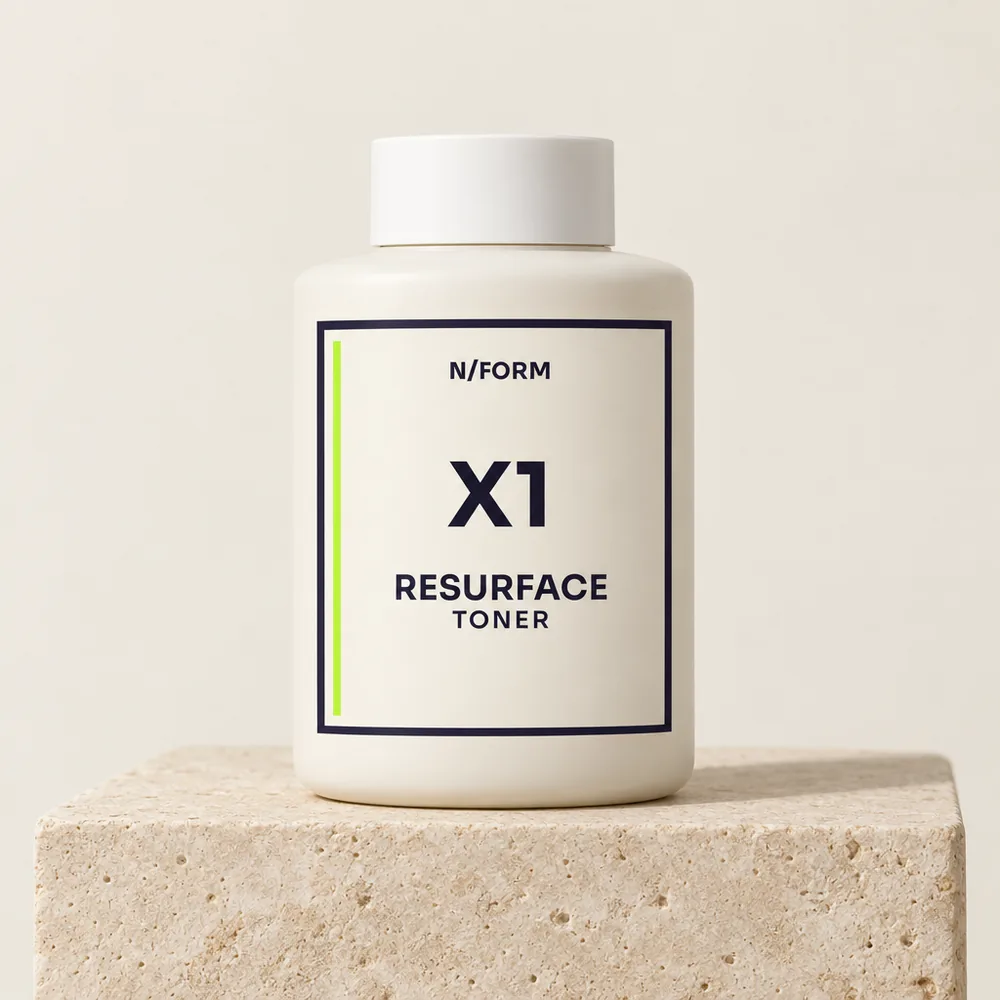
Melanin in a brown mark sits inside skin cells. Those cells rise and shed on the skin's own schedule; glycolic acid, an alpha hydroxy acid (AHA), loosens the bonds between the dead cells at the surface so they shed sooner and thins the compacted outer layer5. It clears the pigmented cells that are already at the top a little faster, cycle after cycle. In a double-blind, placebo-controlled trial, 75 volunteers used 5% glycolic acid daily for three months and their skin texture and discoloration improved significantly against placebo6. Resurface Toner carries 5% glycolic acid and is for two or three evenings a week rather than the daily use of the trial, because AHAs raise sun sensitivity while in use5 and a mark you are trying to fade is the last place you want extra sun.
The pairing works by time of day, vitamin C in the morning and glycolic acid in the evening, and the guide on glycolic acid and vitamin C together explains why that is enough.
How to fade acne marks on a realistic timeline
Honest timelines. A skin cell takes roughly 40 to 56 days to travel from the base of the epidermis to being shed7. Pigment that was delivered into cells near the surface leaves within a cycle or two; pigment that sits deeper takes several. The ascorbyl glucoside trial measured its first significant lightening at 12 weeks and more at 244. The glycolic acid trial ran three months6. Plan on three months before judging the routine and six before deciding a mark is permanent.
Red marks (PIE) follow a different clock, because they are vessels rather than pigment. They fade as the vessels recover, faster if the area is not re-inflamed and not exposed. Neither vitamin C nor glycolic acid targets them directly; both help by keeping the surface healthy while the redness resolves on its own.
Darker skin should plan on the longer end. PIH is more common and lasts longer in darker skin1, and a mark that has been there for a year on deep skin is still a mark, not a scar, if it is flat; it just needs the routine kept up for longer, with sunscreen every single day. The whole-face version of this routine, with the moisturizer and cleanser it sits inside, is the routine for dull, uneven skin.
Questions people ask
How long do acne marks take to fade?
Months. A skin cell takes 40 to 56 days to reach the surface and shed7, and a brown mark is pigment inside those cells, so the earliest visible change is after one full cycle and the usual timeline is three to six months. The half-face trial of ascorbyl glucoside on sun spots measured its first significant lightening at 12 weeks4.
What is the difference between PIH and PIE?
PIH is brown: extra melanin made during inflammation and delivered into skin cells, which is why it responds to ingredients that reduce melanin production and to exfoliation1. PIE is red or pink: dilated small vessels left behind after the breakout. PIE fades as the vessels recover and does not respond to pigment ingredients; it responds to time, sun protection and not re-inflaming the spot.
Does vitamin C work on acne scars?
On acne marks, the flat colored ones, vitamin C is one of the two topical steps: it reduces melanin formation3, and ascorbyl glucoside lightened sun spots significantly at 12 and 24 weeks in a half-face trial4. On acne scars, the pitted or raised ones, no topical vitamin C fills or flattens the texture. Those need a dermatologist.
Why are my acne marks worse on dark skin?
Because the pigment response to inflammation is stronger and the marks last longer in darker skin, which the PIH review states directly1. The routine is the same; the timeline is longer, and daily sunscreen matters more, not less, because sun exposure keeps the marks going.
Can I use glycolic acid on acne marks while I still have breakouts?
Yes, two or three evenings a week, as long as the skin is not raw or inflamed that night. But the marks will keep coming until the breakouts stop, so the acne routine, with a salicylic acid toner for congestion, is the higher priority, and stopping the inflammation comes before any lightening step1.
Sources
Every study cited above, with what it found and where it can be read. A study of an ingredient is not a study of one of our formulas, and we say which kind each one is.
- 1
Davis and Callender, Journal of Clinical and Aesthetic Dermatology, 2010
Review
Review of post-inflammatory hyperpigmentation: it follows any inflammation (acne, injury, irritation), is more common and longer-lasting in darker skin, and treatment starts with stopping the inflammation and daily sun protection before any lightening agent.
- 2
Hughes, Annals of Internal Medicine, 2013
Clinical trial
Randomized trial, 903 adults, 4.5 years: daily sunscreen use showed no detectable increase in skin ageing, against 24% more ageing in the discretionary-use group.
- 3
Telang, Indian Dermatology Online Journal, 2013
Review
Review: topical vitamin C is an antioxidant that supports collagen synthesis and reduces melanin formation, and pure ascorbic acid is unstable and needs a low pH, which is why stabilized derivatives exist.
- 4
Takada, International Journal of Molecular Sciences, 2024
Clinical trial
Double-blind half-face trial, 27 women with sun spots, 24 weeks: the ascorbyl glucoside side lightened significantly against the placebo side at 12 and 24 weeks. Two authors work for the manufacturer, which the paper declares.
- 5
Kornhauser, Clinical, Cosmetic and Investigational Dermatology, 2010
Review
Review of hydroxy acids: AHAs such as glycolic acid loosen the bonds between dead surface cells, thin the compacted outer layer and thicken living epidermis; they also raise sun sensitivity while in use.
- 6
Thibault, Dermatologic Surgery, 1998
Clinical trial
75 volunteers used 5% glycolic acid daily for three months, double-blind and placebo-controlled; skin texture and discoloration improved significantly against placebo.
- 7
Iizuka, Journal of Dermatological Science, 1994
Review
A skin cell takes roughly 40 to 56 days to travel from the base of the epidermis to being shed, which is why a change in skin needs weeks, not days, to show.
The formulas this guide points at
Not sure which of these is your skin?
Seven questions about what your skin does, not what you own, and you get the three formulas that treat it. Sixty days to find out, full refund, keep the bottles.
Read next
Dull and uneven skinRoutine guide
The Routine for Dull, Uneven Skin
Dull skin is dead cells scattering light, too little water and patchy pigment. The routine that fixes all three, from cleanser to sunscreen.
9 min read · 9 sources
Dull and uneven skinGuide
Can You Use Glycolic Acid and Vitamin C Together?
Yes. Vitamin C in the morning, glycolic acid on its two or three evenings, and they never meet. Why the pH worry is mostly about pure ascorbic acid.
6 min read · 6 sources
Oily and congested skinGuide
Skin Purging vs Breakout: How to Tell Which One You Have
Purging is congestion that was already forming, brought up faster by an acid or a retinoid. Where the spots are and how long they last tell you which it is.
7 min read · 5 sources
Dull and uneven skinIngredient
Vitamin C (Ascorbyl Glucoside) for Skin
Ascorbyl glucoside is vitamin C bonded to glucose so it stays stable and does not sting; skin converts it back. What it trades for that, and what trials found.
6 min read · 6 sources