Every skinIngredient
Niacinamide: What It Does for Skin, and What the Trials Found
Niacinamide is vitamin B3. It strengthens the barrier, calms redness, evens tone and lowers sebum, and it has human trials at 2% and 5% behind each of those.
Published September 21, 2026 · 6 min read · 4 sources · By N/FORM
- The evidence
- 2 clinical trials, 2 reviews
- In these formulas
- Tone Support Serum
The short version
- Niacinamide is the amide form of vitamin B3. On skin it raises ceramide production, which strengthens the barrier and reduces water loss, calms inflammation, and reduces the transfer of pigment to surface cells.
- In a 12-week double-blind split-face trial in 50 women, 5% niacinamide improved fine lines, blotchiness, hyperpigmented spots, sallowness and elasticity against the same moisturizer without it.
- In two randomized trials with 100 people in total, 2% niacinamide lowered sebum output within two to six weeks, which makes it the oil-control ingredient with a human measurement behind it.
- It is well tolerated, fragrance-free formulas exist for reactive skin, and it layers with vitamin C, salicylic acid and hyaluronic acid without special rules.
Niacinamide is the amide form of vitamin B3, a water-soluble vitamin, and one of the few skincare ingredients that does several different things with a trial behind each. Applied to skin it raises the production of ceramides, the lipids that hold the outer layer together, which strengthens the barrier and reduces water loss; it calms inflammation; and it reduces the transfer of pigment from the cells that make it to the surface cells that show it1. The niacinamide benefits for skin, in one sentence: a stronger barrier, less redness, more even tone, and less oil, from one well-tolerated ingredient.
What it does
Four mechanisms, from a review of topical niacinamide1.
It builds the barrier. The outer layer of the skin (the stratum corneum) is dead cells set in a mortar of lipids, and ceramides are the main lipid in that mortar. Niacinamide raises ceramide production, and the measurable result is a lower rate of water escaping through the surface. Skin that holds its water is less tight, less flaky and less reactive.
It calms inflammation. Redness, the flush that follows a new product, and the inflammation around a blemish all run through the same signaling, and niacinamide damps it.
It evens tone. Pigment is made in one kind of cell and handed to the surface cells in packets. Niacinamide reduces that transfer, so a dark mark or a blotchy patch fades as the surface renews without the pigment being replaced as fast.
It lowers sebum. This one is a trial finding rather than a mechanism, and it is covered below.
What the trials found
The trial most often cited is a 12-week double-blind, split-face study in 50 women. One side of the face got a moisturizer with 5% niacinamide, the other got the same moisturizer without it. The niacinamide side improved on fine lines, blotchiness, hyperpigmented spots, sallowness and elasticity2. Split-face means each woman was her own control, which is a strong design for a cosmetic ingredient, and 12 weeks is long enough for the surface to have renewed itself.
For oil, two randomized trials with 100 people in total: a product with 2% niacinamide lowered sebum output within two to six weeks against the same product without it3. That is a measurement of the oil itself, not a matte finish, and it is the reason niacinamide belongs in an oily-skin routine as well as a tone one.
The caution is the usual one. A review of the evidence behind the common cosmeceutical ingredients, niacinamide among them, found that the quality varies widely and that concentration and formulation decide whether an ingredient does anything4. The trials above used 2% and 5%. A formula that carries niacinamide as the last item on the list is not the formula in the trial.
How much, and in what
The studied strengths are 2% in the sebum trials and 5% in the tone, lines and elasticity trial2. Niacinamide is water-soluble, which is why it appears in serums, moisturizers and toners alike.
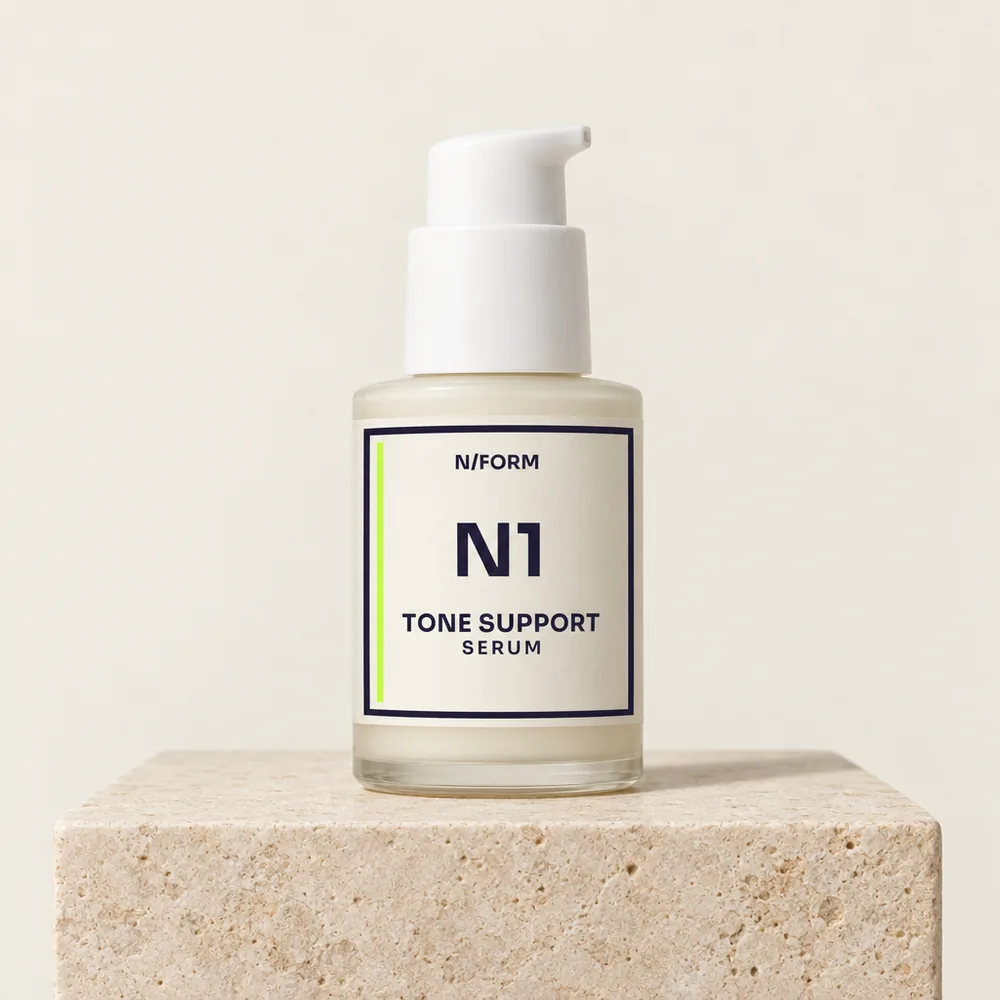
Tone Support Serum is the niacinamide serum in this range. It carries niacinamide with centella asiatica, hyaluronic acid and plant-derived exosomes, and the catalogue does not declare a niacinamide percentage, so none is claimed here. It is fragrance-free with no declared allergens, contains lactic acid at an unpublished level, and is not oil-free: jojoba seed oil is in the formula. The exosomes are small vesicles derived from plant cells, sold as carriers of signaling molecules; there is no trial of them in the evidence behind this page, and the evidence for them is early. Nothing on this page about niacinamide should be read as evidence for them.
Who it suits, and who should go carefully
Almost everyone, which is unusual for an active. The catalogue points Tone Support Serum at reactive skin that needs a serum with no fragrance in it, and at uneven tone, dullness and early lines. The barrier and anti-inflammatory mechanisms are what make it the active most often recommended first for skin that flushes at everything else1. The sensitive, reactive skin routine shows where it sits in a fragrance-free routine.
Oily and combination skin is the other clear match, on the sebum trials3. Note that Tone Support Serum itself carries jojoba oil, so on very oily skin it goes on as a thin layer under an oil-free gel rather than as the moisturizer.
Go carefully in the ordinary way: patch-test a new serum behind the ear or on the jaw for a few days before the whole face, and introduce one new product at a time so that a reaction has a name.
What it works with
Vitamin C. The pair people most often ask about. The worry that niacinamide and vitamin C cancel each other out has no trial behind it in the evidence here, and in practice the two are layered: vitamin C first, niacinamide over it. The vitamin C page covers the stabilized forms and why they do not need a low pH.
Salicylic acid. For oily, congested skin: the acid clears the pore as a toner, niacinamide lowers the oil that fills it as a serum, in that order3. The oily, congested skin routine puts the two together with an oil-free moisturizer.
Hyaluronic acid. Often in the same bottle. Hyaluronic acid draws water into the outer layer; niacinamide helps it stay there by raising the ceramides that slow water loss1.
Exfoliating acids and retinoids. Niacinamide's barrier and anti-inflammatory effects are the reason it is often paired with the actives that irritate1. It goes on in the same routine, serum step, without a special rule; the guide on how to layer skincare has the order.
Questions people ask
What are the niacinamide benefits for skin, in short?
A stronger barrier, less redness, more even tone and less oil. Niacinamide raises ceramide production and reduces water loss, calms inflammation, and reduces pigment transfer to surface cells1. At 5% for 12 weeks it improved fine lines, blotchiness, spots, sallowness and elasticity in a split-face trial of 50 women2.
Is niacinamide good for redness?
Yes, on two mechanisms: it calms inflammation directly and it strengthens the barrier, so the skin reacts less to what touches it1. For redness-prone skin the formula matters as much as the ingredient: a fragrance-free niacinamide serum removes the most common trigger while adding the calming active.
Does niacinamide help oily skin?
Yes, with a human measurement. In two randomized trials with 100 people, 2% niacinamide lowered sebum output within two to six weeks against the same product without it3. It is the oil-control ingredient with a trial behind it, and it pairs with a salicylic acid toner on congested skin.
Can I use niacinamide and vitamin C together?
Yes. The claim that they cancel each other has no trial behind it in the evidence here. Apply vitamin C first, then niacinamide, or use a stabilized vitamin C derivative that does not need a low pH, and the two sit together without difficulty.
How do I use a niacinamide serum?
After cleansing and toner, before moisturizer, morning or evening or both. Two or three drops over the face, a moment to absorb, then the moisturizer and, in the morning, sunscreen. Give it the trial window. The sebum trials saw their result at two to six weeks3. The tone trial ran 12 weeks2.
Is niacinamide safe for sensitive skin?
It is one of the better-tolerated actives, and its barrier and anti-inflammatory effects are the reason it is often the first active recommended for reactive skin1. Choose a fragrance-free formula, patch-test for a few days, and introduce it alone so any reaction can be traced.
Sources
Every study cited above, with what it found and where it can be read. A study of an ingredient is not a study of one of our formulas, and we say which kind each one is.
- 1
Wohlrab and Kreft, Skin Pharmacology and Physiology, 2014
Review
Review of topical niacinamide: it strengthens the barrier by raising ceramide production, reduces water loss, calms inflammation and reduces the transfer of pigment to surface cells.
- 2
Bissett, Dermatologic Surgery, 2005
Clinical trial
50 women, 12 weeks, double-blind, split-face: 5% niacinamide improved fine lines, blotchiness, hyperpigmented spots, sallowness and elasticity against the same moisturizer without it.
- 3
Draelos, Journal of Cosmetic and Laser Therapy, 2006
Clinical trial
Two randomized trials, 100 people in total: 2% niacinamide lowered sebum output within two to six weeks against the same product without it.
- 4
Levin and Momin, Journal of Clinical and Aesthetic Dermatology, 2010
Review
Review of the evidence behind common cosmeceutical ingredients (retinol, vitamin C, niacinamide, hydroxy acids, peptides): the evidence quality varies widely and concentration and formulation decide whether an ingredient does anything.
The formula this guide points at
Not sure which of these is your skin?
Seven questions about what your skin does, not what you own, and you get the three formulas that treat it. Sixty days to find out, full refund, keep the bottles.
Read next
Sensitive and reactive skinRoutine guide
The Routine for Sensitive, Reactive Skin
Four fragrance-free steps for skin that stings, flushes or flares at products, how to add a product without a reaction, and when to see a doctor.
9 min read · 12 sources
Oily and congested skinRoutine guide
The Routine for Oily, Congested Skin
Oily, congested skin needs a cleanser that does not strip it, salicylic acid inside the pore, and an oil-free gel moisturizer. The order and the timing.
9 min read · 8 sources
Dull and uneven skinIngredient
Vitamin C (Ascorbyl Glucoside) for Skin
Ascorbyl glucoside is vitamin C bonded to glucose so it stays stable and does not sting; skin converts it back. What it trades for that, and what trials found.
6 min read · 6 sources
Every skinGuide
How to Layer Skincare: The Order That Actually Matters
Thinnest to thickest, water before oil, actives on clean skin, moisturizer last and sunscreen over it by day. The order, the pairs to separate, and why.
7 min read · 7 sources