Dull and uneven skinIngredient
Ferulic Acid for Skin: What It Does Next to Vitamin C
A plant antioxidant that stabilizes vitamin C and, in pig skin, doubled a vitamin C and E solution's photoprotection. What that study did and did not test.
Published September 21, 2026 · 5 min read · 3 sources · By N/FORM
- The evidence
- 2 reviews, 1 laboratory study
- In these formulas
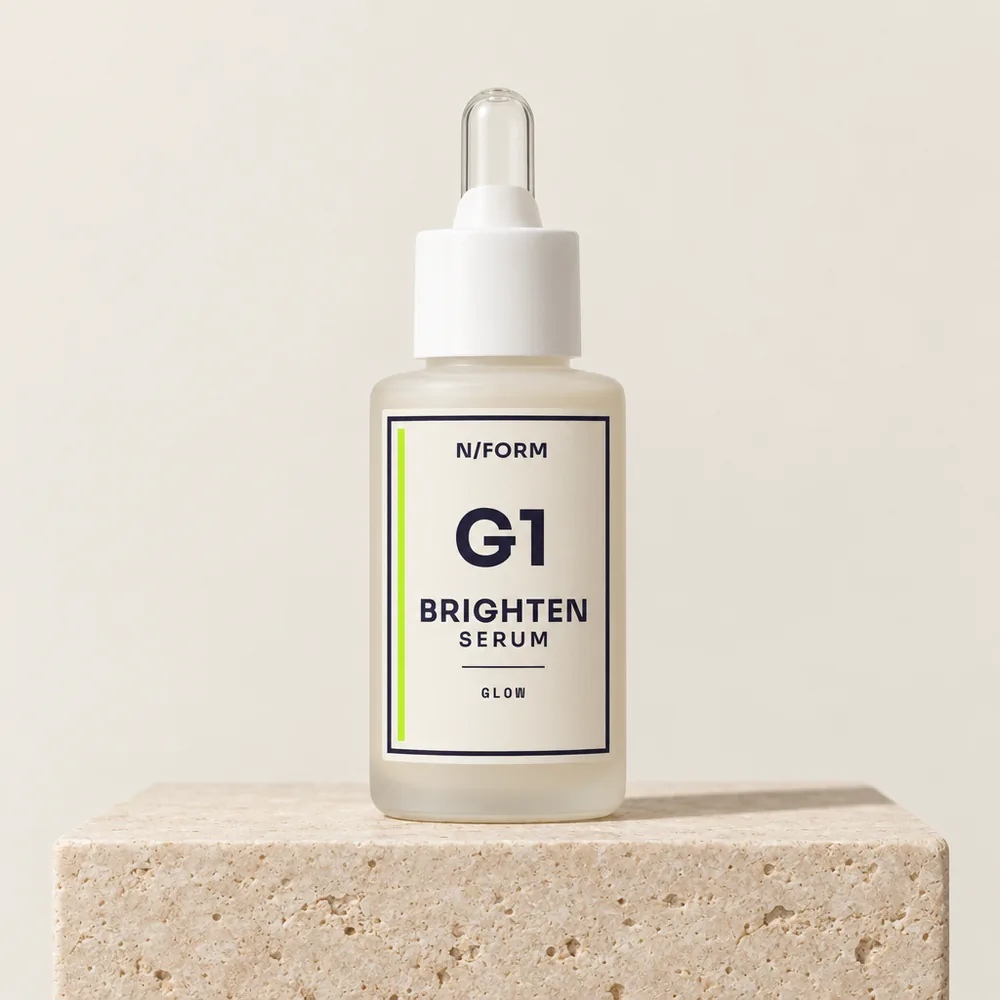
- Brighten Serum
The short version
- Ferulic acid is an antioxidant found in the cell walls of plants such as rice, oats and wheat. In skincare it is used to stabilize vitamin C and to add its own antioxidant protection.
- The study behind the pairing found that adding 0.5% ferulic acid to a vitamin C and E solution doubled its photoprotection, from 4-fold to about 8-fold, and stabilized both vitamins. It was done on pig skin with pure L-ascorbic acid, not on people and not with ascorbyl glucoside.
- Brighten Serum carries 1% ferulic acid with 2% ascorbyl glucoside. The ferulic acid is there as the antioxidant partner; no trial in our bank tests that exact pairing.
- Ferulic acid is an antioxidant, not a sunscreen. Wear sunscreen over any vitamin C and ferulic acid serum.
Ferulic acid is an antioxidant that plants make in their cell walls; rice bran, oats and wheat are the usual sources. In skincare it almost always appears next to vitamin C, because the study that made it famous found it did two things at once in that setting: it stabilized the vitamin C and vitamin E it was mixed with, and it doubled the mixture's protection against ultraviolet damage. The ferulic acid skin benefits, in one sentence, are extra antioxidant protection and a vitamin C that keeps working longer, with the honest note that the evidence is from pig skin, not people.
What it does
An antioxidant neutralizes the reactive molecules that ultraviolet light and pollution generate in skin, the ones that damage cell membranes, proteins and the pigment system. Vitamin C is the best-known topical antioxidant: it supports collagen synthesis and reduces melanin formation, and its pure form is unstable and needs a low pH, which is why stabilized forms and stabilizing partners exist1. Ferulic acid is one of those partners. It is an antioxidant in its own right, and in a formula it takes some of the oxidative load that would otherwise be spent on the vitamin C, which is the plain-language version of "stabilizes".
That is what it does. It does not exfoliate, it does not lighten pigment on its own, and it is not a sunscreen.
What the trials found
There is one study to know, and it is worth knowing exactly. Researchers added 0.5% ferulic acid to a solution of L-ascorbic acid and vitamin E and applied it to pig skin before exposing the skin to ultraviolet light. With the ferulic acid, the solution's photoprotection doubled, from 4-fold to about 8-fold, and both vitamins were more stable in the solution2.
Three things about that result. It was pig skin, not people, so it shows what the chemistry does in skin tissue and not what a face looks like after months of use. It used pure L-ascorbic acid, not ascorbyl glucoside, so the result belongs to that pairing and cannot be transferred to a derivative without a study of its own. And it measured protection during a controlled exposure, not the everyday tone or texture that a person buying a serum wants to see change. The wider review of cosmeceutical ingredients says the same thing about the field: evidence quality varies widely, and concentration and formulation decide whether an ingredient does anything3. For ferulic acid the evidence is a good mechanism study and not much else. That is the honest summary.
How much, and in what
The study used 0.5%2. Brighten Serum carries 1% ferulic acid alongside 2% ascorbyl glucoside, 1% sea-buckthorn oil and hyaluronic acid. It is a morning serum: apply it to clean skin, let it sink in, then moisturizer and sunscreen. The vitamin C page explains why the vitamin in that serum is the glucoside rather than the pure acid; the short version is stability and comfort at a normal pH. Because the famous study was done with pure L-ascorbic acid and vitamin E, the doubling result is the reason ferulic acid is in the formula, not a result the formula has been shown to give. We say that plainly because the alternative is to let a pig-skin result stand in for a claim about a bottle.
Who it suits, and who should go carefully
Ferulic acid suits anyone using a vitamin C serum, which is to say most skin with uneven tone, marks left after breakouts, or a dull cast from years of sun. It has no sun-sensitivity warning and no exfoliating action, so it does not need the evening slot or the frequency limits that glycolic acid does; it simply belongs in the morning where an antioxidant earns its place. The routine for dull, uneven skin puts the serum in its morning step.
Go carefully with the formula rather than the ingredient. Brighten Serum contains fragrance and, in the US formula, the declared allergens limonene, citral, linalool and citronellol, and it contains sweet almond oil, so it is not nut-free. If you are avoiding fragrance or have a nut allergy, that is the thing to know before buying.
What it works with
Vitamin C. The pairing it exists for. The stabilizing and photoprotection result is with L-ascorbic acid and vitamin E in pig skin2; with ascorbyl glucoside the rationale is the same and the specific study has not been done.
Sunscreen. Over the top, every morning. An antioxidant works by mopping up damage after light gets in; sunscreen stops most of it getting in. The pig-skin study measured added protection, not replacement2.
Glycolic acid. Not on the same application, for the same reason as vitamin C: the serum belongs in the morning and the acid in the evening, and the guide on glycolic acid and vitamin C together explains the split.
Questions people ask
What does ferulic acid do for skin?
It is an antioxidant that, mixed with vitamin C and vitamin E, stabilized both vitamins and doubled their photoprotection against ultraviolet light in pig skin, from 4-fold to about 8-fold2. On its own it is a modest antioxidant; its value is in what it does for the vitamin C beside it.
Are ferulic acid skin benefits proven in people?
Not in a clinical trial we can cite. The doubling-of-photoprotection study was on pig skin, with pure L-ascorbic acid and vitamin E2, and the review of cosmeceutical evidence is clear that formulation and concentration decide whether an ingredient does anything3. The mechanism is sound; the human trial is missing.
Can you use ferulic acid without vitamin C?
You can, but there is little reason to. Its documented value is as a stabilizer and partner for vitamin C2; on its own it is one antioxidant among many, with no trial of its own in our bank.
Is 1% ferulic acid a good concentration?
The study that showed the stabilizing and photoprotective effect used 0.5%2, so 1% is at or above the level tested. More is not better beyond that, and nothing in the evidence supports a higher percentage doing more.
Does ferulic acid replace sunscreen?
No. It is an antioxidant that adds protection to a vitamin C and E solution2; it does not block ultraviolet light. Vitamin C reduces melanin formation and supports collagen1, and both jobs are undone by unprotected sun. Sunscreen goes on over the serum every morning.
Sources
Every study cited above, with what it found and where it can be read. A study of an ingredient is not a study of one of our formulas, and we say which kind each one is.
- 1
Telang, Indian Dermatology Online Journal, 2013
Review
Review: topical vitamin C is an antioxidant that supports collagen synthesis and reduces melanin formation, and pure ascorbic acid is unstable and needs a low pH, which is why stabilized derivatives exist.
- 2
Lin, Journal of Investigative Dermatology, 2005
Laboratory study
Adding 0.5% ferulic acid to a vitamin C and E solution doubled its photoprotection, from 4-fold to about 8-fold, and stabilized both vitamins. Pig skin, not people.
- 3
Levin and Momin, Journal of Clinical and Aesthetic Dermatology, 2010
Review
Review of the evidence behind common cosmeceutical ingredients (retinol, vitamin C, niacinamide, hydroxy acids, peptides): the evidence quality varies widely and concentration and formulation decide whether an ingredient does anything.
The formula this guide points at
Not sure which of these is your skin?
Seven questions about what your skin does, not what you own, and you get the three formulas that treat it. Sixty days to find out, full refund, keep the bottles.
Read next
Dull and uneven skinIngredient
Vitamin C (Ascorbyl Glucoside) for Skin
Ascorbyl glucoside is vitamin C bonded to glucose so it stays stable and does not sting; skin converts it back. What it trades for that, and what trials found.
6 min read · 6 sources
Dull and uneven skinGuide
Can You Use Glycolic Acid and Vitamin C Together?
Yes. Vitamin C in the morning, glycolic acid on its two or three evenings, and they never meet. Why the pH worry is mostly about pure ascorbic acid.
6 min read · 6 sources
Dull and uneven skinRoutine guide
The Routine for Dull, Uneven Skin
Dull skin is dead cells scattering light, too little water and patchy pigment. The routine that fixes all three, from cleanser to sunscreen.
9 min read · 9 sources