Sensitive and reactive skinIngredient
Centella Asiatica (Cica) for Skin: What It Does and What the Evidence Is
Centella asiatica is the plant behind cica skincare. Its triterpenes are anti-inflammatory and support repair, which is why it is used on sensitive skin.
Published September 21, 2026 · 5 min read · 2 sources · By N/FORM
- The evidence
- 2 reviews
- In these formulas
- Tone Support Serum
The short version
- Centella asiatica is a small creeping herb whose leaf extract carries four triterpenes, asiaticoside, madecassoside, asiatic acid and madecassic acid, which are the molecules behind cica skincare.
- A cosmetology review credits those triterpenes with anti-inflammatory activity and with supporting collagen synthesis and wound repair, which is the basis for using centella on sensitive and healing skin.
- The evidence in our source bank is that review, not a clinical trial on redness, so the case for centella is mechanism and traditional use rather than a measured effect size.
- Centella is fragrance-free and well suited to reactive skin, and it pairs naturally with niacinamide, which has the trial evidence centella lacks.
- Tone Support Serum carries Centella asiatica leaf extract at an undeclared percentage alongside niacinamide, in a formula with no parfum and no declared allergens.
Centella asiatica is a small creeping herb, also called gotu kola or tiger grass, whose leaf extract is the ingredient behind every product labeled "cica". The extract carries a group of molecules called triterpenes, of which asiaticoside, madecassoside, asiatic acid and madecassic acid are the ones that matter, and the centella asiatica skin benefits come down to what those four do: a cosmetology review credits them with anti-inflammatory activity and with supporting collagen synthesis and wound repair, which is why the plant is used on sensitive and healing skin1. For skin that flushes and stings, that anti-inflammatory activity is the point.
What it does
The outer layer of your skin (the stratum corneum) is a wall of flattened dead cells in a lipid mortar. Its job is to keep water in and irritants out, and when it is damaged, water loss rises and more of what you apply reaches the living cells underneath, where redness and stinging begin2. Skin that reacts is usually skin whose barrier is letting too much through, and an ingredient that calms the response underneath while the barrier repairs is worth having.
That is where centella sits. The review evidence is that its triterpenes have anti-inflammatory activity, which is the property behind its use on skin that is red or irritated, and that they support collagen synthesis and wound repair, which is the property behind its long use on cuts, burns and scars1. Madecassoside is the triterpene most often named on labels. The extract is water-soluble, fragrance-free and does not exfoliate, so it adds nothing for a reactive skin to react to.
What the trials found
The source in our bank for centella is a review of the plant's use in cosmetology, and a review is a survey of the literature, not a trial1. It summarizes the mechanism, the anti-inflammatory and repair activity of the triterpenes, and the history of the plant's use, and on that basis it supports centella as an ingredient for sensitive and healing skin1. It does not give an effect size for redness, a percentage that was tested on faces, or a head-to-head against another calming ingredient, and this page will not invent one.
In practice: centella is well founded as a mechanism and long used for this purpose, but the calming ingredient with a measured trial behind it is niacinamide, which is why the two are usually formulated together. And a cosmetic serum is not a wound treatment; a healing cut or a burn is a doctor's job.
How much, and in what
The review in our bank does not fix a cosmetic strength1. Centella extracts also vary in how much triterpene they carry, so a percentage on a label tells you less than it would for an acid. Cosmetic products carry the leaf extract, or a purified fraction such as madecassoside, at levels the formulator chooses.
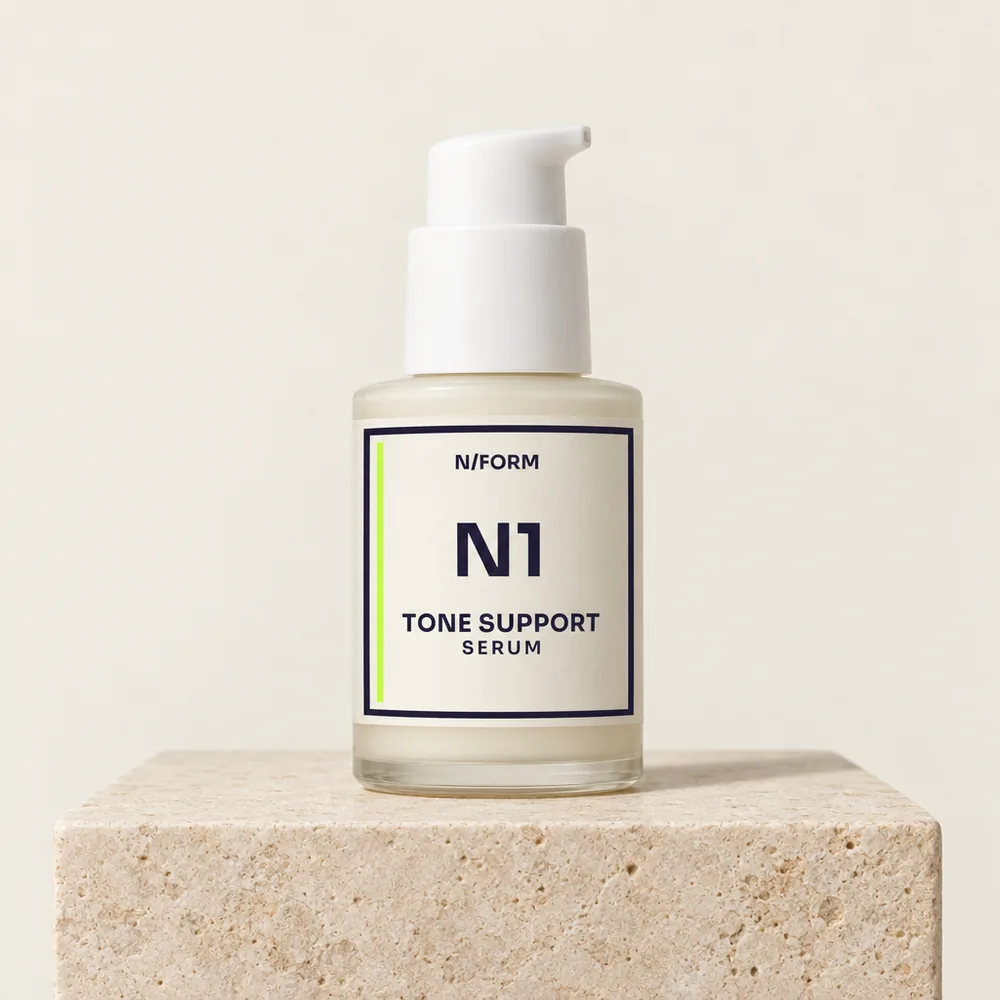
In the N/FORM range, Tone Support Serum carries Centella asiatica leaf extract alongside niacinamide, hyaluronic acid and plant exosomes. The catalogue does not declare a percentage for the centella and neither does this page. The serum has no parfum and no declared allergens. It also contains lactic acid at a level the label does not state, and it is not oil-free, because jojoba seed oil is in the formula; both are worth knowing before it goes on reactive skin.
Who it suits, and who should go carefully
Centella suits skin that flushes, stings at products or is recovering from over-exfoliation, a retinoid or a harsh cleanser, which is the skin the routine for sensitive, reactive skin is built for. It also suits skin working through the red and brown marks a flare leaves behind, where calming the inflammation is the first step.
Go carefully if you are allergic to plants in the carrot family, which centella belongs to; a patch test behind the ear for three to five nights is the sensible check, as it is for anything new on reactive skin. And go carefully with expectations: if the barrier is badly damaged, the fix is to stop supplying irritants and let it repair, which how to fix a damaged skin barrier walks through, and centella is a helper in that process, not the process.
What it works with
Niacinamide is the natural partner. It brings the trial evidence for barrier strengthening and calming that centella lacks, and the two are fragrance-free, water-based and non-exfoliating, so they layer without conflict. A humectant such as hyaluronic acid underneath and a plain moisturizer on top complete the routine: the humectant puts water into the outer layer, the moisturizer holds it there, and a barrier that is losing less water is one that is keeping more out2.
What it does not need is company from acids or retinoids while the skin is reactive. Those thin the barrier that centella is there to protect, and a calming ingredient cannot outrun an exfoliant applied on top of it.
Questions people ask
What are the centella asiatica skin benefits?
Calming and repair. A cosmetology review credits centella's triterpenes with anti-inflammatory activity and with supporting collagen synthesis and wound repair, which is the basis for its use on sensitive and healing skin1. The evidence is a review of the mechanism and the plant's history of use, not a trial that measured redness on faces.
What is cica in skincare?
Cica is the marketing short form of Centella asiatica. A cica cream or serum is one that carries the leaf extract or one of its purified triterpenes, most often madecassoside, for skin that is red, reactive or recovering.
Is centella good for redness?
The review evidence supports it: the triterpenes are anti-inflammatory, and redness on reactive skin is inflammation under a barrier that is letting too much through1. What the bank does not contain is a trial that measured how much redness fell, so treat centella as a well-founded calming ingredient rather than one with a number attached.
Can I use centella with niacinamide?
Yes, and it is the usual pairing. Both are fragrance-free, water-based and non-exfoliating, and niacinamide brings trial evidence for barrier strengthening and calming that complements centella's mechanism. Tone Support Serum carries both.
Does centella asiatica help with acne scars?
The review credits its triterpenes with supporting collagen synthesis and wound repair, which is the rationale for its traditional use on scars1. That is mechanism and history, not a trial on acne scars, and a cosmetic serum does not treat pitted scarring. For flat red or brown marks after a breakout, calming the inflammation comes first, and centella suits that.
Sources
Every study cited above, with what it found and where it can be read. A study of an ingredient is not a study of one of our formulas, and we say which kind each one is.
- 1
Bylka, Advances in Dermatology and Allergology, 2013
Review
Review of Centella asiatica in cosmetics: its triterpenes support collagen synthesis and wound repair and have anti-inflammatory activity, which is the basis for its use on sensitive and healing skin.
- 2
Proksch, Experimental Dermatology, 2008
Review
Review of the skin barrier: the stratum corneum’s corneocytes and lipid matrix limit water loss and keep irritants out, and barrier damage is measurable as raised transepidermal water loss.
The formula this guide points at
Not sure which of these is your skin?
Seven questions about what your skin does, not what you own, and you get the three formulas that treat it. Sixty days to find out, full refund, keep the bottles.
Read next
Sensitive and reactive skinRoutine guide
The Routine for Sensitive, Reactive Skin
Four fragrance-free steps for skin that stings, flushes or flares at products, how to add a product without a reaction, and when to see a doctor.
9 min read · 12 sources
Every skinIngredient
Niacinamide: What It Does for Skin, and What the Trials Found
Niacinamide is vitamin B3. It strengthens the barrier, calms redness, evens tone and lowers sebum, and it has human trials at 2% and 5% behind each of those.
6 min read · 4 sources
Sensitive and reactive skinGuide
How to Fix a Damaged Skin Barrier (and How Long It Takes)
A damaged barrier stings, flakes and flushes at products it used to tolerate. What broke it, the three-step repair routine, what to stop, and how many weeks.
7 min read · 12 sources